
APPLICATION:
Mixed Traffic Intersections
TECH DEPLOYED:
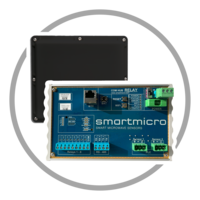
TOPGRD & COM HUB Relay 8
DETECTION GOAL:
Collision Risk Detection
Improving VRU Safety Using Smart Intersection Technology in Bielefeld
In September 2025, the city of Bielefeld collaborated with smartmicro to further develop the traffic situation at a busy tram stop. Schools and assisted living facilities are located in the immediate vicinity, resulting in a complex interplay of motorized traffic, bicycle traffic, and pedestrian flows. The aim of the project was to implement a reliable and future-proof detection solution that would create a robust basis for optimized traffic light control.
The Challenge
The location presented several challenges. New pedestrian traffic lights were installed at both ends of the tram stop. At the same time, the road is heavily trafficked in both directions and is used intensively by cyclists. The immediate proximity to the tram further increases the complexity of the traffic situation.
Against this backdrop, there was a need for a detection solution that covers large detection areas, is economically viable, and can be integrated without invasive intervention in the existing infrastructure.
The Solution
To meet these requirements, smartmicro implemented a smart intersection solution based on TOPGRD radar sensors in combination with the COM HUB Relay 8. Two TOPGRD sensors were installed on each of the two new traffic light poles to detect incoming and outgoing traffic in both directions. The sensors' large detection range enables reliable detection of motor vehicles and bicycles across multiple lanes, regardless of weather or light conditions.
Each pair of sensors was connected to its own COM HUB Relay 8. This compact edge device was specially developed for traffic management applications and acts as an interface between radar detection and traffic light control. With eight relay outputs, the COM HUB Relay 8 enables the detection information to be directly converted into defined control signals for the traffic computer.
The COM HUB Relay 8 also helps to reduce technical complexity on site. It bundles the sensor data, provides a standardized interface to the existing traffic light system, and enables easy commissioning via the browser-based Traffic Web UI. Integrated surge and lightning protection as well as configuration options via LAN or WLAN ensure reliable and low-maintenance operation. HD-PLC communication also allows sensors to be connected at distances of up to 300 meters using just a 3-wire cable.
The solution not only creates a stable detection basis for the current application, but also provides a scalable foundation for future traffic technology expansions.
The installation was completed in around four hours with minimal disruption to ongoing traffic. Thanks to the above-ground mounting of the sensors and the plug-and-play concept of the COM HUB Relay 8, the system could be integrated efficiently and without extensive intervention in the infrastructure.
The Results and Benefits
With the new installation, the city of Bielefeld now has a precise and economical detection solution for motorized traffic and bicycle traffic at a challenging inner-city location. The data collected makes it possible to design traffic light control systems that are more responsive to demand and adapted to actual traffic volumes.
The COM HUB Relay 8 proved to be a central element of the system architecture. It provides a simple and robust connection between the sensor technology and traffic control, reduces integration costs, and minimizes maintenance requirements. At the same time, it enables flexible further development of the system without the need for fundamental hardware changes.
The Conclusion
The project in Bielefeld demonstrates how the combination of smartmicro TOPGRD radar sensors and the COM HUB Relay 8 creates a powerful and economical solution for complex traffic situations. Reliable traffic detection and direct integration into traffic light control systems create a sustainable basis for optimized traffic management.
The COM HUB Relay 8 plays a central role as the link between modern radar technology and practical traffic management.