
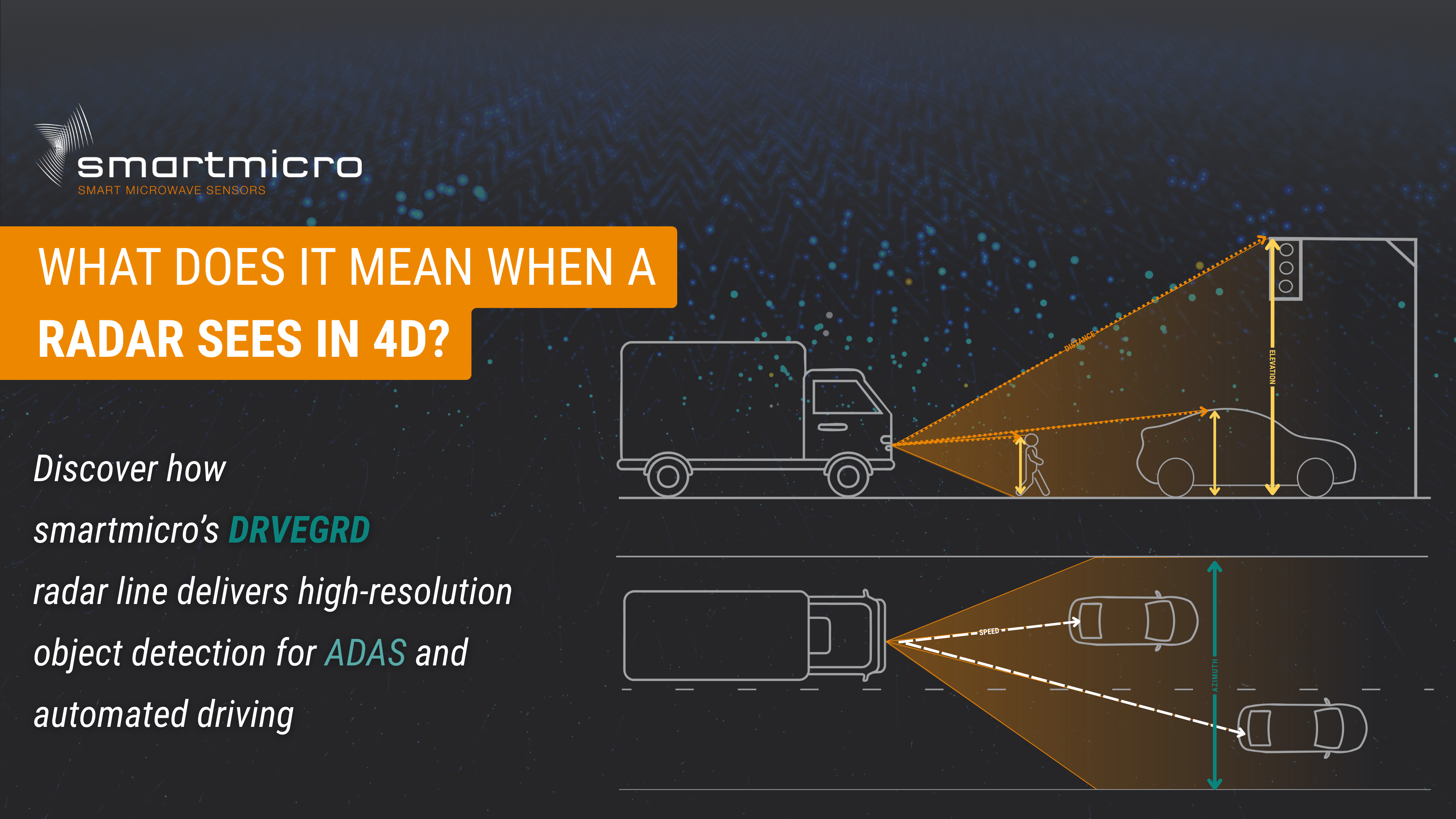
As the automotive industry advances toward higher levels of autonomy and smarter driver assistance systems, radar technology is evolving rapidly. One of the most important innovations in this space is 4D radar — a technology that significantly enhances environmental perception. But what exactly does "4D" mean in the context of radar? And why is it essential for applications like ADAS, autonomous vehicles, and industrial mobility?
This article explores what 4D radar is, how smartmicro implements it through its DRVEGRD radar product line, and the real-world advantages it brings to modern vehicle platforms.
What Does It Mean When a Radar Sees in 4D?
4D Radar = 4 Key Target Dimensions
- Range – how far the object is
- Speed (Doppler) – how fast it is moving toward or away
- Azimuth angle – the object’s horizontal direction
- Elevation angle – its vertical position (e.g. above or below)
This enables vehicles to distinguish whether a target is a cyclist on the road, a pedestrian on a sidewalk, or a bridge overhead — all in real time.
What Is PxHD?
smartmicro takes 4D radar one step further with what it calls PxHD – Pixel-High Definition. This means the radar can:
- Separate objects that are very close together
- Maintain clarity in dense environments
- Provide precise, high-resolution target tracking
This pixel-level separation across all four dimensions gives smartmicro’s sensors an edge over conventional radar systems, especially in complex traffic scenarios.
How DRVEGRD Radar Sensors Make 4D and PxHD a Reality
smartmicro’s DRVEGRD radar line is engineered to deliver 4D and PxHD performance. These radars integrate a range of advanced hardware and signal processing technologies to enable high-definition object detection and tracking.
Key Enabling Technologies:
- 6T8R MIMO Antenna Array
6 transmit and 8 receive antennas create up to 48 virtual channels, enabling precise angle resolution. - Patented A/B CS-FMCW Waveform
Combines range and unambiguous Doppler speed measurement in a single radar cycle. Super Resolution Processing
Enables precise separation in range and angle, even when targets are very close together.
Example: DRVEGRD 171 Performance
The DRVEGRD 171 is an example of smartmicro’s 4D radar capabilities, offering robust performance across a wide range of scenarios:
- Detection range: Up to 240 meters
- Speed separation: Greater than or equal to 0.26 meters per second
- Angle resolution: Approximately 2 degrees
- Azimuth accuracy: Less than or equal to 0.25 degrees
- Elevation accuracy: Less than or equal to 0.5 degrees
Whether operating in city traffic, on highways, or in industrial zones, this level of precision ensures reliable object tracking and classification.
Why 4D Radar Matters on the Road
The advantages of 4D radar are clear — especially in demanding, real-world driving environments.
Real-World Benefits of 4D and PxHD Radar:
- Reliable separation of multiple targets in close proximity
- Improved classification of vulnerable road users such as pedestrians and cyclists
- Reduced false positives from environmental noise or static clutter
Enhanced tracking accuracy in urban, highway, and industrial use cases
This high-definition perception forms the foundation for safety-critical features such as:
- Adaptive Cruise Control
- Emergency Braking
- Lane Change Assist
- Collision Avoidance
Full-autonomy support for shuttles and logistics vehicles
Future-Ready Radar for ADAS and Autonomous Driving
smartmicro’s DRVEGRD product line delivers the 4D radar technology required for advanced driver assistance systems, autonomous navigation, and industrial automation.
Whether you are developing next-generation mobility platforms or enhancing your ADAS stack, 4D and PxHD radar perception is a critical enabler of safe, reliable, and intelligent driving.