How FMCW Radar Works
FMCW (Frequency-Modulated Continuous Wave) radar is the technology behind many of today’s automotive, traffic management, and industrial sensing applications. By continuously transmitting and receiving radio signals, FMCW radar delivers precise distance and velocity measurements, reliable object detection, and high-resolution environmental awareness. Its ability to perform consistently in challenging weather and lighting conditions has made it the preferred radar technology for applications where accuracy, reliability, and real-time performance are essential.
Understanding the Technology Behind High-Performance Radar Sensors
Modern radar technology is transforming the way vehicles, infrastructure, and Intelligent Transportation Systems (ITS) perceive their surroundings. From Advanced Driver Assistance Systems (ADAS) to traffic management, FMCW radar enables precise object detection, reliable tracking, and real-time insights—even in rain, fog, snow, darkness, and other challenging environmental conditions.
Unlike traditional pulse radar, FMCW radar continuously transmits and receives radio signals. By analyzing the difference between transmitted and reflected signals, it accurately determines the distance, speed, and direction of multiple objects simultaneously. This combination of continuous transmission, advanced waveform design, and efficient signal processing has made FMCW the preferred sensing technology for modern traffic sensors, automotive radar, and industrial sensing applications.

The Working Principle of FMCW Radar
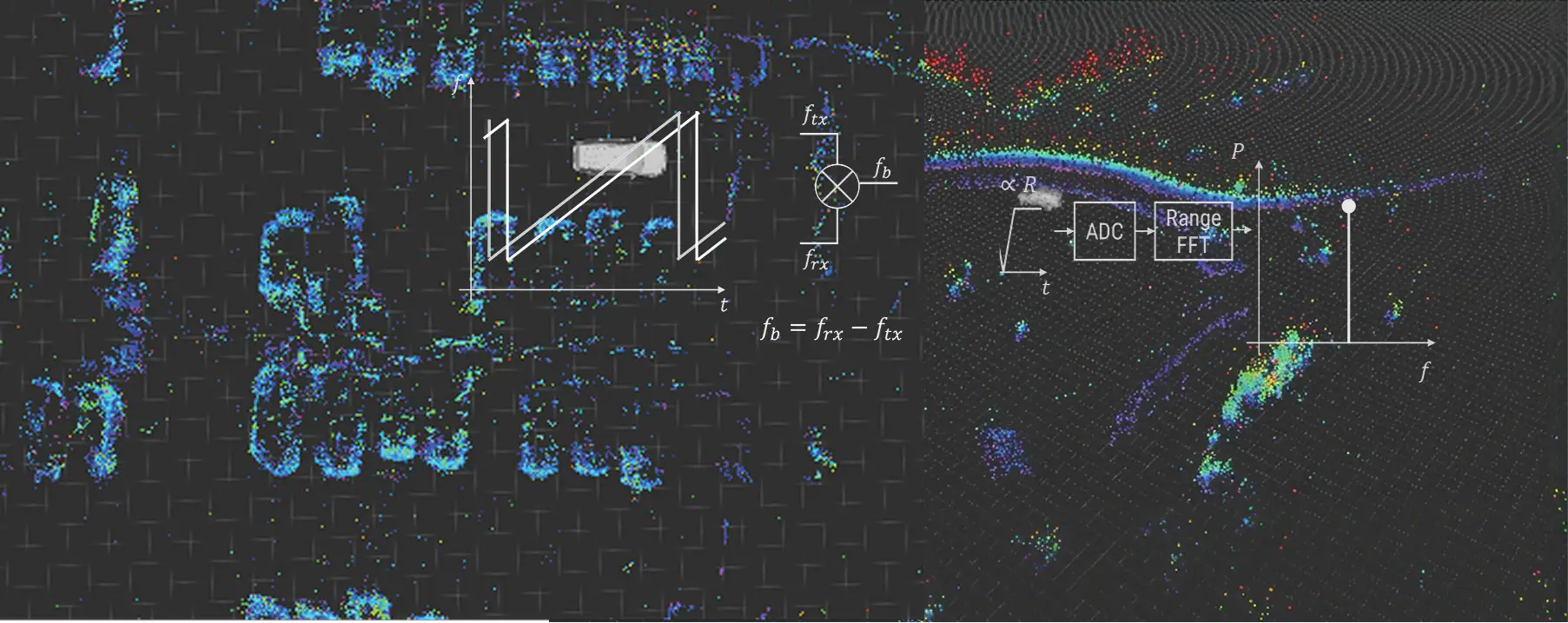
Unlike conventional pulse radar, Frequency Modulated Continuous Wave (FMCW) radar continuously transmits and receives radio signals. Instead of emitting individual pulses, the transmitted signal is modulated using a sequence of linear frequency ramps, commonly referred to as chirps.
Each chirp is reflected by objects within the radar’s field of view and received with a time delay proportional to the target’s distance. By comparing the transmitted and received signals, the radar determines the resulting beat frequency, which directly corresponds to the target’s range. A single chirp therefore enables the radar to resolve multiple objects at different distances within the measurement scene.
However, determining a target’s motion requires more than a single frequency ramp. Modern chirp sequence FMCW (CS-FMCW) radar transmits multiple chirps within a single measurement cycle. By coherently processing information from consecutive chirps, the radar measures the Doppler frequency generated by moving targets and accurately determines their radial velocity.
This simultaneous evaluation of range and Doppler information enables reliable detection of high-speed, low-speed, and stationary objects while maintaining high measurement accuracy in dynamic environments.
Advanced Signal Processing and 4D Radar
The performance of a modern FMCW radar sensor is determined not only by its waveform but also by its signal processing capabilities.
Advanced algorithms process the received radar echoes across multiple chirps and antenna channels to separate targets in range, velocity, and angle. Fast Fourier Transform (FFT) processing converts the received signals into a multidimensional representation, allowing multiple objects to be distinguished even when they are located at similar distances or moving with comparable velocities.
Modern 4D radar systems further extend this principle by combining multiple transmit and receive antennas using MIMO (Multiple Input Multiple Output) technology. In addition to measuring range and velocity, these systems estimate a target’s azimuth and elevation, enabling high-resolution environmental perception and precise object localization.
The resulting four-dimensional measurement space—range, velocity, azimuth, and elevation—provides the detailed environmental information required for traffic management, traffic enforcement, highway monitoring, intersection monitoring, ADAS, and industrial sensing applications.

Why FMCW Radar Is the Preferred Technology for Traffic Management
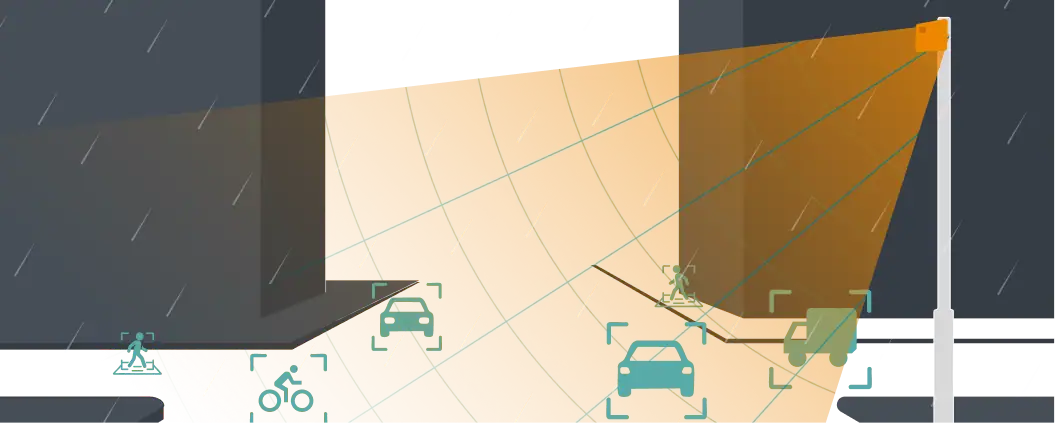
Modern traffic management systems require reliable detection under a wide range of environmental conditions. FMCW radar provides continuous monitoring of vehicles, pedestrians, cyclists, and other road users while maintaining high accuracy in rain, fog, darkness, and glare. Unlike camera-only systems, radar performance is not dependent on visibility or ambient lighting, making it a dependable traffic sensor for critical infrastructure.
These capabilities support a wide range of applications, including intersection monitoring, highway monitoring, traffic data collection, traffic flow analysis, vehicle counting, and adaptive traffic signal control. By delivering real-time information about traffic flow, vehicle speed, and occupancy, FMCW radar helps traffic operators improve road safety, optimize mobility, and make informed traffic management decisions.
Applications of FMCW Radar
The ability of FMCW radar to simultaneously measure range, velocity, and direction makes it the preferred sensing technology for intelligent mobility applications. Combined with advanced signal processing, radar delivers reliable object detection and continuous situational awareness across a wide range of traffic scenarios.

Intersection Monitoring
Modern intersection monitoring systems rely on FMCW radar to detect vehicles, pedestrians, cyclists, and other vulnerable road users (VRUs) in real time. Continuous monitoring supports adaptive traffic signal control, conflict detection, and improved road safety.

Highway Monitoring
For highway monitoring, FMCW radar enables continuous multi-lane vehicle detection, speed measurement, and traffic flow analysis. Reliable operation in adverse weather conditions makes radar an ideal technology for long-term traffic monitoring.

Traffic Enforcement
Reliable speed measurement and precise vehicle detection are essential for modern traffic enforcement systems. FMCW radar combines accurate Doppler measurement with advanced signal processing to monitor vehicles across multiple lanes while maintaining reliable performance under varying environmental conditions.
Bridge Monitoring
Radar sensors installed on bridges provide continuous traffic detection without requiring invasive road installations. They support traffic data collection, vehicle counting, and long-term infrastructure monitoring while reducing maintenance requirements.

Tunnel Monitoring
Within tunnels, visibility can be affected by lighting conditions, smoke, or weather at tunnel entrances. FMCW radar provides reliable vehicle detection regardless of lighting conditions, supporting incident detection, traffic management, and operational safety.

Roundabout Monitoring
Roundabouts require continuous tracking of vehicles approaching from multiple directions. FMCW radar enables accurate object detection and movement analysis, supporting safer and more efficient traffic operations.
Smart City Applications
As cities continue to invest in Smart Cities and Intelligent Transportation Systems (ITS), FMCW radar provides reliable traffic data for traffic management, mobility optimization, and infrastructure planning. Applications include vehicle counting, traffic flow monitoring, adaptive traffic signal control, and real-time traffic analytics.
smartmicro’s Patented A/B CS-FMCW Technology
The capabilities of modern FMCW radar extend beyond continuous transmission. Waveform design, antenna architecture, and high-performance signal processing together determine measurement quality, target separation, and detection reliability.
smartmicro radar sensors employ a patented A/B fast chirp-sequence FMCW (A/B CS-FMCW) modulation. While conventional CS-FMCW radar measures target velocity through coherent processing of multiple chirps, smartmicro’s patented waveform enables direct, unambiguous Doppler measurement across the complete specified speed interval within a single measurement cycle.
Combined with advanced signal processing, this technology enables precise measurement of target range and velocity, while resolving multiple objects located at the same distance but traveling at different radial velocities—or objects moving at similar speeds but positioned at different ranges.
Together with multiple transmit and receive antennas, smartmicro 4D radar sensors also determine a target’s azimuth and elevation, providing high-resolution environmental perception for demanding traffic management, traffic enforcement, intersection monitoring, and highway monitoring applications.